
EU Plastic Packaging Data 2026: What It Means for PPWR Compliance and Recyclable Flexible Packaging
EU Plastic Packaging Data 2026: What It Means for PPWR Compliance
New EU data confirms flexible plastic packaging is not going away. The real question for food and consumer brands is whether it can be recycled, and how fast that transition can happen.
Every few months, a new regulatory deadline or industry report lands and the packaging conversation shifts again. This time it is data, not policy, and it is worth sitting with.
The European Commission's Joint Research Centre, the Commission's in-house science service, published a study in July 2026 covering 19 EU countries and tracking packaging placed on the market from 2011 to 2025. Because it feeds directly into how member states report and monitor packaging waste, the numbers carry real regulatory weight.
Every other packaging material held steady or declined over the same period. Plastic did not. And the report is specific about where that growth is concentrated: dairy products are named explicitly among the categories weighing most heavily on the scale, alongside bottled water and soft drinks. The methodology has also been expanded to track personal care and household categories for the first time, a signal that this growth is not confined to food and beverage.
The Question Is Not Whether, But How
It would be easy to read this data as bad news. Years of sustainability commitments, and plastic packaging keeps climbing. But that framing misses the more useful question underneath it.
Flexible plastic remains one of the most effective packaging formats available to food and beverage brands, particularly where barrier performance, shelf life, and cost all need to hold at once. No other material matches that combination at the same price point and production speed. That is precisely why brands keep choosing it, year after year, regardless of the sustainability conversation happening around them.
The real question isn't whether flexible plastic keeps being used. It's whether it can be recycled.
Most flexible packaging in circulation today is multi-material: several layers of different polymers bonded together, each contributing something different, barrier, seal strength, print surface, but impossible to separate once combined. That inseparability is exactly what makes it non-recyclable, and it is exactly the gap the EU's Packaging and Packaging Waste Regulation was written to close.
The August 12 Deadline
From August 12, 2026, Regulation EU 2025/40 requires a Declaration of Conformity per SKU for packaging placed on the European market, and multi-material laminates do not meet the recyclability requirements the regulation sets out. This is not a distant policy conversation. It is a market access deadline, and it applies to the packaging formats most food and consumer brands are running today.
Put the two pieces of information together and the picture becomes clear. The volume of flexible plastic packaging in the European market was never going to shrink on its own. The only variable brands can still meaningfully control is whether that packaging is recyclable.
A Mono-Material Structure Solves This Directly
The technical answer to a multi-material problem is a mono-material structure: one polymer family throughout the film, nothing left to separate at end of life, genuinely recyclable within existing European recycling streams. This is not a new idea in principle. What has been missing is a version of it that does not ask brands to give up the packaging format that already works for them.
To succeed commercially, a mono-material solution has to be built around real industry needs and the existing supply chain, so that the path to PPWR compliance stays short, clear, and free of the operational disruption that has kept many brands from making the switch sooner.
What That Takes In Practice
Fast To Implement
A proven high-barrier and ultra-high-barrier technology means brands are matched to a working structure, not a from-scratch R&D cycle.
No Capex Required
Compatible with existing filling and sealing lines, no new equipment, no requalification process.
Cost-Effective
Priced to compete directly with the multi-material structures brands are already running.
Fully Approved
Food-contact compliance and certifications built in from the start, not added on afterward.
Built To Specification
Matched to each brand's real barrier, production line, and shelf-life requirements.
Performance That Holds
Recyclability and long-term shelf performance are designed together, not traded off against each other.
What MeloPack Actually Is
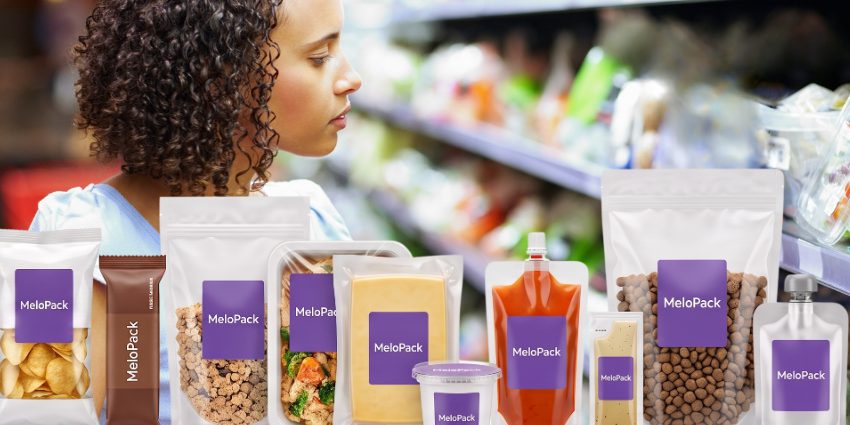
At Melodea, this is exactly what MeloPack was built for. It is a recyclable, transparent, food-contact certified, mono-material flexible packaging solution, engineered specifically to meet PPWR recyclability requirements while working within the format and supply chain a brand already has in place.
MeloPack is built on Melodea's patented MelOx-NGen™ and VBseal™ coating platforms, developed in-house over more than a decade and proven at commercial scale. The solution is available in three mono-material structures, BOPP + MelOx-NGen™ + PP, PE + MelOx-NGen™, and Bio PE + MelOx-NGen™, each delivering high and ultra-high barrier performance in a transparent film, certified for direct food contact under EU EC 10/2011, FDA, and BfR standards.
Structures are delivered as printed rollstock within 30 days of specification, from €6/kg, competitive with the multi-material laminates most brands are already running. A Technical Data Sheet and Certificate of Analysis are provided per production batch.
Where This Is Already Working
MeloPack is already deployed in commercial food applications, including sifted flour, spices, and avocado spread, in each case without new equipment, capital expenditure, or production downtime. Dairy applications, the category the JRC report names explicitly as one of the heaviest contributors to plastic packaging growth, are a particular focus, given how closely barrier performance and shelf life are tied together in that category.
"We wanted to upgrade our existing non-recyclable packaging for our avocado spread and break into new retail markets. Shelf life was critical. Switching to MeloPack extended our shelf life significantly, and opened doors we could not reach before."Packaging Manager, Food Brand
The Practical Takeaway
The JRC data does not change what food and consumer brands already know: flexible plastic packaging works, and it is not going anywhere. What it does is add regulatory and market weight to a question packaging teams across Europe are already asking themselves, quietly or otherwise, ahead of the August 12 deadline.
That question is not whether to keep using flexible plastic. It is whether the plastic already moving through the supply chain can become recyclable without asking the business to rebuild that supply chain from the ground up.
MeloPack is not a future promise. It is available now, food-contact certified, and built to each brand's own specifications.
For a category growing at the rate this report describes, the brands that move first on recyclability are the ones that will not be scrambling for a solution when August 12 arrives.
Book A Free Packaging Assessment
Share your current packaging format and we will return a mono-material match, with barrier data, food contact certification, lead time, and pricing from €6/kg.
Talk To Us About Your PPWR Timeline →