Recyclable Food Packaging Innovation for 2027: Paper or Film, Explained
Recyclable Food Packaging Innovation for 2027: Paper or Film, Explained
A plain-language guide to where recyclable mono-material packaging stands today, what changes under PPWR, and how to choose between paper and film for your product.

- Recyclable food packaging now comes in two proven mono-material routes: paper (repulpable, PTS & Cepi) and film (transparent, from €6/kg, drop-in on existing lines).
- Both routes use the same barrier platform — Melodea's MelOx‑NGen™ and VBseal™ coatings — applied to a single material instead of a multi-layer laminate.
- PPWR is already in force in the EU, and California's SB 54 enters its own implementation phase on 1 January 2027, which makes 2027 the year to prepare on both sides of the Atlantic, not the deadline itself.
"Recyclable packaging" gets used as if it's one thing. It isn't. A food brand weighing its options for 2027 is really choosing between two different mono-material routes, paper or film, each built on the same idea: put a water-based barrier coating directly onto a single material instead of laminating a second or third material on top of it. Get that right and the pack recycles as what it's made of. Get it wrong and "recyclable" is a claim on the box, not a fact about the bin.
This guide walks through what counts as genuine recyclable packaging innovation heading into 2027, what the EU's Packaging and Packaging Waste Regulation (PPWR) actually requires and when, and how to choose between a paper structure and a film structure for a specific product. Both are PPWR-ready, both are food-contact compliant, and both are built by Melodea as an in-house converter, so the step from sample to production line stays short.
Every Melodea structure, paper or film, is built on the same MelOx‑NGen™ and VBseal™ coatings, engineered at minimal thickness for maximum protection.
What Counts as Recyclable Packaging Innovation in 2027?
Not every pack labeled "recyclable" actually is, once it's in the stream. The test that matters is simple: can the pack be sorted, processed and recycled as a single material, or does it need to be separated first? A laminate of paper and foil, or film and metallized layers, fails that test even if one layer is technically recyclable on its own. Genuine innovation in 2027 means mono-material packaging: one material carrying the full barrier load, whether that material is paper or film.
That's also why "mono-material" leads every piece of packaging Melodea builds, in paper or film, with High or Ultra-High Barrier performance built in rather than bolted on. The barrier comes from a transparent, water-based coating applied directly onto the base material, not from an additional layer of a different material.
Why 2027 Is the Preparation Year, Not the Deadline Year
PPWR became applicable across the EU on 12 August 2026, which is why most "PPWR-ready" messaging already assumes the regulation is live. But the requirements that actually force a packaging redesign, how a pack must be built to count as recyclable, phase in over several more years. Based on the regulation's published timeline, the schedule looks roughly like this:
| Date | What happens |
|---|---|
| 12 Aug 2026 | PPWR applicable; food-contact PFAS restrictions and initial labeling obligations begin. |
| 1 Jan 2028 | The European Commission is due to adopt delegated acts setting design-for-recycling criteria and recyclability performance grades (A through E). |
| 1 Jan 2030 | Packaging must meet recyclability grades A, B or C to be placed on the market; recycled-content minimums begin for the film parts of packaging. |
| 1 Jan 2038 | The bar rises again: only grades A or B remain permitted. |
Timeline summarized from public reporting on Regulation (EU) 2025/40; always verify current dates against the official regulation before making a compliance decision.
The same pressure is building on the other side of the Atlantic. California's SB 54, the state's Plastic Pollution Prevention and Packaging Producer Responsibility Act, moves into its implementation phase on 1 January 2027, on the way to 2032 targets that include 100% recyclable, compostable or reusable packaging and a 25% cut in single-use plastic packaging. Two different regulatory systems, converging on the same packaging logic: fewer materials, verified recyclability, less waste by design.
In practice, that makes 2027 the preparation window. The design-for-recycling criteria that will define "grade A" packaging are still coming from the Commission, but the direction is already clear enough to act on: fewer materials per pack, coatings instead of laminations, and a documented, repulpable or single-stream recyclable structure. Brands that move now are choosing their structure on their own timeline, not scrambling to meet a grade they didn't see coming.
Paper or Film: Which Recyclable Structure Fits Your Product?
The honest answer is that it depends on what the product needs, not on which material sounds more sustainable. Melodea works with brands on both routes, and recommends paper where paper genuinely fits the barrier and format, and film where film remains the practical choice, rather than treating either as a blanket replacement for the other.
The Paper Route
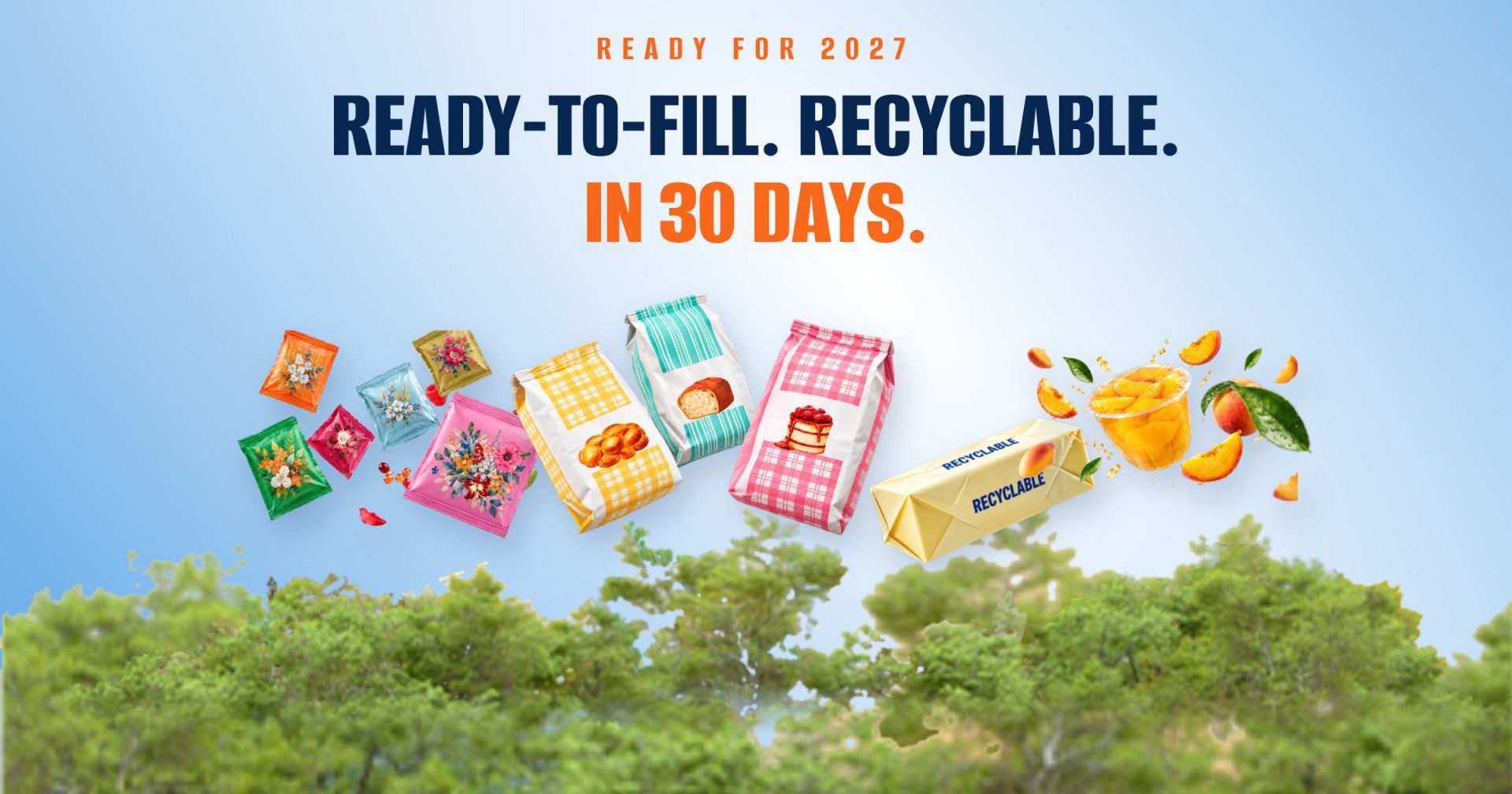
Paper suits products where the brand wants to move off foil or film entirely, think butter wraps, tea sachets, and other dry or semi-dry goods where repulpability is the priority. The structure is the same across these products: a single paper substrate carrying both barrier coatings.

See the recyclable paper packaging line
Explore Paper SolutionsThe Film Route
Film stays the practical choice where a brand needs transparency so the customer can see the product, a competitive price point, or a drop-in fit on an existing coating or pouch-making line without new capital investment. The same barrier platform is applied to a single film substrate instead of a paper one.

See the recyclable film packaging line
Explore Film SolutionsHow Does Mono-Material Packaging Actually Get Recycled?
Paper and film are recycled through different streams, and a mono-material structure is what lets each one enter its stream cleanly. A paper pack built as paper plus a thin water-based coating is repulpable: it can go into paper recycling and break down in the pulping process the way uncoated paper does, rather than contaminating the batch the way a foil laminate would. A film pack built as a single film type is recyclable within existing film recycling streams, because sorting equipment can identify and process one material, not separate three laminated layers first.
That's the practical difference between a coating and a laminate. A laminate adds a second material to get a barrier property. A coating, applied thin and directly onto the base material, adds the same barrier property without changing what the pack is made of.
Who's Already Making the Switch?
The shift isn't theoretical. A leading butter brand moved from an aluminum-foil-and-wax-paper wrap to a recyclable paper structure. A leading tea brand replaced a paper-and-metallized-BOPP sachet with a fully recyclable paper one, without losing aroma retention. On the film side, a pet vitamin manufacturer needed a mono-material, ultra-high barrier flow-pack to replace a PET-aluminum-PE laminate, and found it in a metalized BOPP structure instead. Three different products, three different barrier needs, the same underlying approach: one material, one coating platform, no laminate to separate at end of life.

From foil to a recyclable paper pouch — the same switch now playing out across paper and film categories.
Frequently Asked Questions
Is mono-material packaging actually recyclable, or is that just a claim?
It's a structural fact, not a claim on the box. A mono-material pack is made of one material carrying its own barrier coating, so it can be sorted and recycled in that material's existing stream, paper or film, without separating layers first.
What's the real difference between paper and film recyclable packaging?
Paper is repulpable and suits products where a brand wants off foil or film entirely, with pricing separate from film. Film stays transparent, is priced from €6/kg, and drops into existing coating or pouch-making lines without new capital investment.
Do we need to change our production line to switch to recyclable packaging?
Usually not. Melodea's barrier coatings are print-ready with solvent-based inks and standard adhesives, and run on commonly available equipment such as gravure, slot dies and curtain coating, so most brands can integrate them onto an existing line.
What does "PPWR-ready" actually mean?
It means the packaging is built as mono-material now, ahead of the design-for-recycling criteria and recyclability grades the European Commission is due to set from 2028, so the structure doesn't need to be redesigned again when those grades take effect.
How fast can we get a sample?
For film structures, samples are typically ready in around 30 days after a short discovery step on barrier level, shelf life and production line. Paper structures are scoped the same way, matched to an already-proven mono-material solution rather than built from scratch.
Find the Right Structure for 2027
Paper or film, every product has a different barrier requirement. See which Melodea mono-material structure fits yours.
Explore MeloPack