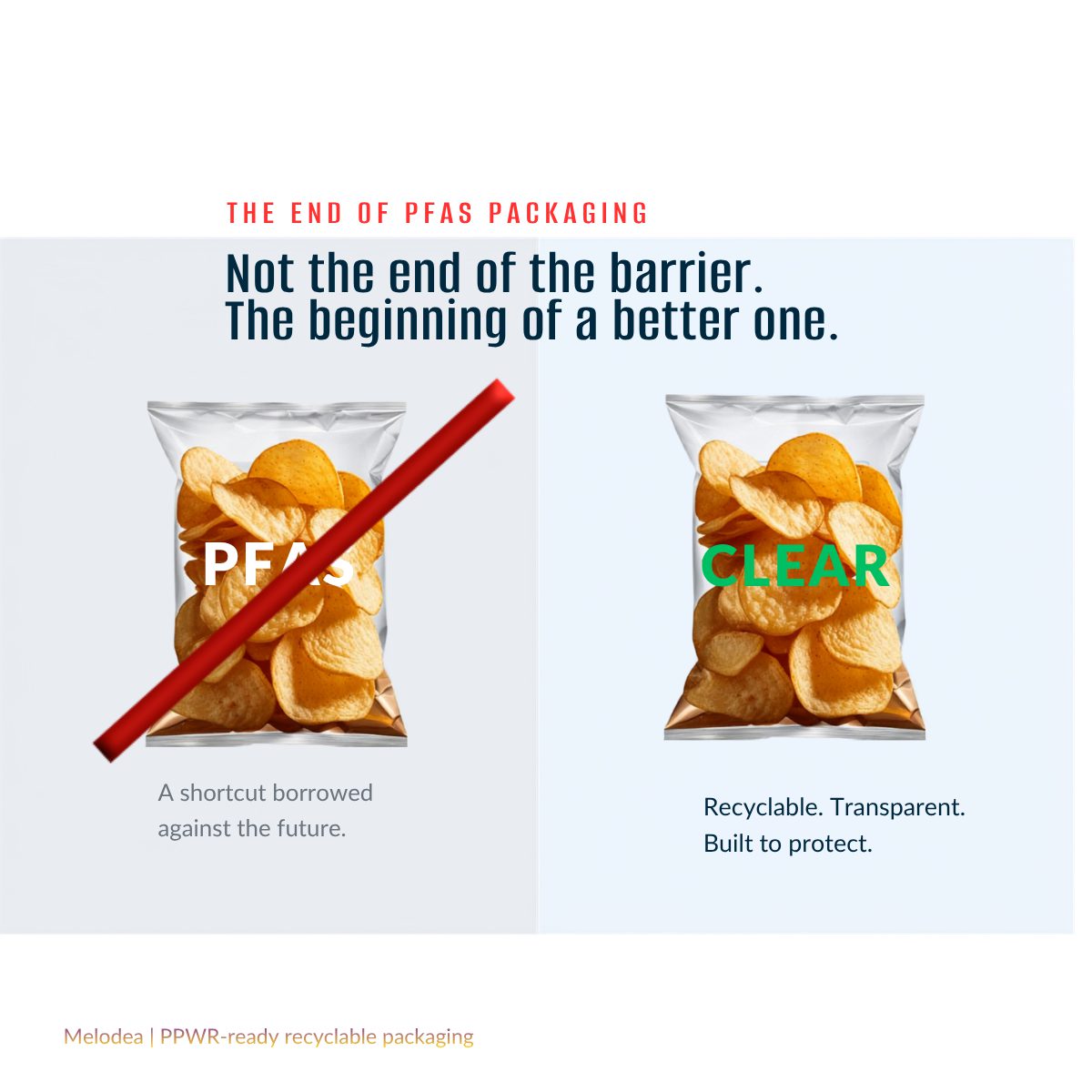

Regulation & Barrier Innovation Beyond the PFAS& PPWR Deadline: Reinventing the Barrier for a Circular Economy
Beyond the PFAS Deadline: Reinventing the Barrier for a Circular Economy
The August 2026 ban is not a compliance hurdle to clear and forget. It is an invitation to rebuild food packaging on materials that were never the problem, without giving up the protection your product depends on.
Melodea | Regulation & Solutions
The industry press has started calling it the end of PFAS packaging, and for once the headline is not an exaggeration. A regulatory shift that has been discussed for years now has a fixed date attached to it, and the packaging value chain is moving from planning to execution. For brands, converters and material suppliers alike, the question has changed from whether to act to how quickly they can.
At Melodea, this is the exact problem we have spent years solving. So rather than restate the regulation, we want to talk about what actually has to change underneath it, and why the companies that started early are already in a stronger position.
The wall the industry is walking toward
On August 12, 2026, the European Union's Packaging and Packaging Waste Regulation (PPWR) makes it unlawful to place food-contact packaging containing intentionally added PFAS above strict limits on the European market. There is no transition period and no grandfather clause. Packaging manufactured before the deadline cannot be sold after it if it exceeds the limits, which means existing non-compliant stock does not get a grace period to sell through.
For decades, PFAS, the substances often described as forever chemicals, were the default answer to a single stubborn problem. How do you make paper and fibre packaging resist grease, oil and moisture without the pack failing? Coffee cups, takeaway boxes, bakery bags, food wrappers, the barrier that kept them functional was, very often, built on PFAS chemistry.
The regulation removes that answer. What it does not remove is the underlying problem. Food still needs to be protected. Shelf life still needs to hold. Filling lines still need to run at speed. And that is where the real work begins.
The real challenge is not compliance. It is the barrier.
It is tempting to frame August 2026 as a box-ticking exercise. Swap the coating, pass the migration test, move on. But that framing misses what makes this transition genuinely difficult, and genuinely interesting.
The function PFAS delivered, a high-performance barrier against grease and moisture, is not optional. It is the reason the packaging exists. Strip out PFAS without a real replacement for that barrier and you are left with a pack that fails at the one job it was designed to do. Product quality drops, waste rises, and the sustainability gain you were chasing evaporates because spoiled food is far more damaging to the environment than the packaging around it.
The right question is not how do we remove PFAS. It is how do we rebuild the barrier, from materials that belong in a circular economy instead of working against it.
That distinction matters, because the two easy paths both fail. A PFAS-free coating that breaks recyclability solves one regulatory problem while creating the next. A recyclable structure with no real barrier performance is not a solution at all, it simply moves the failure from the regulator's desk to the supermarket shelf. What the market needs, and what the PPWR is effectively demanding, is both at once. Performance and circularity, in the same material. That is what design for recyclability really means in practice: not recyclability bolted on at the end, but a structure engineered from the start to protect the product and re-enter the recycling stream cleanly.
It is also where the largest opening sits. A great deal of today's food packaging still relies on hard-to-recycle multi-material film, chosen historically because it was the only way to stack up enough barrier. Removing PFAS forces that assumption to be re-examined, and for many products the answer is now a recyclable alternative to multi-material film built on a single-polymer structure. Replacing multi-material film with mono-material solutions is no longer a sustainability aspiration on a roadmap. With a barrier that actually holds, it is a practical, available substitution.
What we have been building at Melodea
This is precisely the problem our technology was built to solve. Melodea's barrier coatings deliver oil, grease and moisture resistance without PFAS and without the forever chemistry that turned those materials into a liability in the first place. Just as importantly, they are engineered so the finished packaging is recyclable at end of life, rather than solving the barrier and quietly breaking the recycling stream.
Our MelOx-NGen™ and VBseal™ coating technologies make it possible to build mono-material packaging that performs where it used to be assumed only multi-layer laminates or PFAS-treated fibre could. The coatings are transparent, so brands do not have to trade shelf appeal for compliance, and they are certified for direct food contact under the relevant EU, FDA and BfR frameworks.
For flexible film, that comes together in three proven mono-material structures: BOPP + MelOx-NGen™ + PP, PE + MelOx-NGen™, and Bio PE + MelOx-NGen™. Each is available in High-Barrier and Ultra-High-Barrier variants, so the barrier can be matched to the product rather than over-specified or under-delivered. And because these are proven structures rather than concepts, the route from decision to production is measured in weeks.
Why a real barrier is the harder half of the problem
Recyclability, on its own, has become relatively well understood. Mono-material design, single-polymer streams, compatibility with existing recycling infrastructure, these are now familiar goals across the industry. The part that separates a viable solution from a marketing claim is whether the barrier holds up once the PFAS is gone.
Different products demand very different things from a barrier. A dry, sensitive powder such as a spice or a sifted flour has one set of needs. A fatty or aromatic product has another. A long ambient shelf life places entirely different demands than a short chilled one. A credible PFAS-free solution has to flex across those cases without forcing the brand back toward the laminates and coatings the regulation is designed to eliminate.
This is why we do not treat barrier as a single number to hit. We treat it as a spec to match. High-Barrier and Ultra-High-Barrier options exist so that a brand packing a robust product is not paying for protection it does not need, and a brand packing something delicate is not left short. The barrier is fitted to the product, not the other way around.
Fast, because the solution is already proven
One of the most common misconceptions about moving off PFAS is that it means a long, uncertain development programme. It does not have to. Our process is deliberately fast, and that speed comes from starting with a proven solution rather than a blank page.
It begins with a short discovery conversation about what the brand actually needs. What is being packed, what barrier performance the product requires, what shelf life the market expects, and what the existing production line looks like. From there, we match those needs to the proven mono-material structure and barrier variant that fits, using our proprietary coating combination. It is a fit-to-proven process, not a build-from-scratch one, and that is what compresses the timeline from specification to printed, production-ready rollstock into weeks rather than seasons.
The structures are compatible with flexographic printing and standard form-fill-seal equipment, which removes the two objections that usually stall a packaging change: capital investment and production downtime. When the new material runs on the lines you already have, the barrier to switching drops dramatically, and the deadline stops looking like a threat.
A note on format: film where film fits, paper where paper fits
Flexible film is the preferred format where it fits best, and for a large share of food categories that is exactly the case. But it is not the only answer, and we do not pretend otherwise. For products where a fibre-based format is genuinely the better fit, we also have paper-transition solutions built on the same barrier thinking.
The point is not to defend one format over another. It is to give brands a route to compliance that does not force a compromise on protection, recyclability or line compatibility, whichever format their product calls for.
Why the companies that started early already have the edge
Because there is no sell-through period for non-compliant stock, the deadline arrives all at once. That turns August 2026 into a supply-chain problem as much as a materials one. Qualifying a new coating, validating it on existing lines, securing volume and printing production rollstock all take time, and that time shrinks by the day.
The companies treating the deadline as a wall are, in most cases, the ones that waited. The companies treating it as an opening are the ones that began reformulating early. They will be ready not just to comply, but to put a more recyclable, better-protected product on shelf while competitors are still qualifying alternatives. In a market where retailers and consumers are both watching the sustainability story closely, that is a real commercial advantage, not just a regulatory one.
The regulatory picture reinforces the same direction. This is not an isolated PFAS rule, it is part of a broader wave of packaging legislation driving mono-material adoption and design for recovery across Europe. Brands that build toward circular flexible packaging now are aligning with where the rules are heading, not just where they stand today.
The industry conversation has already shifted. The question is no longer whether recyclable, PFAS-free barrier packaging is possible. It is how quickly a brand can get it onto the line.
The bottom line
The end of PFAS in food packaging is not the end of high-performance packaging. It is the beginning of a better version of it, one where the barrier does its job, the material earns its place in a circular economy, and compliance is a by-product of good design rather than the whole objective.
That is the future we are building toward, and it is available now, not at some point on the horizon. If you are navigating the road to August 2026, the practical next step is simpler than the regulation makes it sound.
Talk to us about your packaging
Tell us what you are packing, what shelf life you need, and what your line looks like. We will tell you which PFAS-free, recyclable structure fits.
Explore MeloPackBeyond the PFAS Deadline: Reinventing the Barrier for a Circular Economy
The August 2026 ban is not a compliance hurdle to clear and forget. It is an invitation to rebuild food packaging on materials that were never the problem, without giving up the protection your product depends on.
Melodea | Regulation & Solutions
The industry press has started calling it the end of PFAS packaging, and for once the headline is not an exaggeration. A regulatory shift that has been discussed for years now has a fixed date attached to it, and the packaging value chain is moving from planning to execution. For brands, converters and material suppliers alike, the question has changed from whether to act to how quickly they can.
At Melodea, this is the exact problem our technology was built around. From the start, it was clear to us that this solution had to be structural, built into the material rather than bolted on later. So rather than restate the regulation, we want to talk about what actually has to change underneath it, and why the companies that started early are already in a stronger position.
The wall the industry is walking toward
On August 12, 2026, the European Union's Packaging and Packaging Waste Regulation (PPWR) makes it unlawful to place food-contact packaging containing intentionally added PFAS above strict limits on the European market. There is no transition period and no grandfather clause. Packaging manufactured before the deadline cannot be sold after it if it exceeds the limits, which means existing non-compliant stock does not get a grace period to sell through.
For decades, PFAS, the substances often described as forever chemicals, were the default answer to a single stubborn problem. How do you make paper and fibre packaging resist grease, oil and moisture without the pack failing? Coffee cups, takeaway boxes, bakery bags, food wrappers, the barrier that kept them functional was, very often, built on PFAS chemistry.
The regulation removes that answer. What it does not remove is the underlying problem. Food still needs to be protected. Shelf life still needs to hold. Filling lines still need to run at speed. And that is where the real work begins.
The real challenge is not compliance. It is the barrier.
It is tempting to frame August 2026 as a box-ticking exercise. Swap the coating, pass the migration test, move on. But that framing misses what makes this transition genuinely difficult, and genuinely interesting.
The function PFAS delivered, a high-performance barrier against grease and moisture, is not optional. It is the reason the packaging exists. Strip out PFAS without a real replacement for that barrier and you are left with a pack that fails at the one job it was designed to do. Product quality drops, waste rises, and the sustainability gain you were chasing evaporates because spoiled food is far more damaging to the environment than the packaging around it.
The right question is not how do we remove PFAS. It is how do we rebuild the barrier, from materials that belong in a circular economy instead of working against it.
That distinction matters, because the two easy paths both fail. A PFAS-free coating that breaks recyclability solves one regulatory problem while creating the next. A recyclable structure with no real barrier performance is not a solution at all, it simply moves the failure from the regulator's desk to the supermarket shelf. What the market needs, and what the PPWR is effectively demanding, is both at once. Performance and circularity, in the same material. That is what design for recyclability really means in practice: not recyclability bolted on at the end, but a structure engineered from the start to protect the product and re-enter the recycling stream cleanly.
It is also where the largest opening sits. A great deal of today's food packaging still relies on hard-to-recycle multi-material film, chosen historically because it was the only way to stack up enough barrier. Removing PFAS forces that assumption to be re-examined, and for many products the answer is now a recyclable alternative to multi-material film built on a single-polymer structure. Replacing multi-material film with mono-material solutions is no longer a sustainability aspiration on a roadmap. With a barrier that actually holds, it is a practical, available substitution.
What we have been building at Melodea
This is precisely the problem our technology was built around from the start. It was clear to us early on that a real answer could not be a coating added at the end to satisfy a regulation, it had to be engineered into the material itself. Melodea's barrier coatings deliver oil, grease and moisture resistance without PFAS and without the forever chemistry that turned those materials into a liability in the first place. Just as importantly, they are engineered so the finished packaging is recyclable at end of life, rather than solving the barrier and quietly breaking the recycling stream.
Our MelOx-NGen™ and VBseal™ coating technologies make it possible to build mono-material packaging that performs where it used to be assumed only multi-layer laminates or PFAS-treated fibre could. The coatings are transparent, so brands do not have to trade shelf appeal for compliance, and they are certified for direct food contact under the relevant EU, FDA and BfR frameworks.
For flexible film, that comes together in three proven mono-material structures: BOPP + MelOx-NGen™ + PP, PE + MelOx-NGen™, and Bio PE + MelOx-NGen™. Each is available in High-Barrier and Ultra-High-Barrier variants, so the barrier can be matched to the product rather than over-specified or under-delivered. And because these are proven structures rather than concepts, the route from decision to production is measured in weeks.
See it in action: meet MeloPack
Our recyclable, PPWR-ready mono-material packaging, a transparent high-barrier film that runs on the lines you already have.
Explore MeloPackWhy a real barrier is the harder half of the problem
Recyclability, on its own, has become relatively well understood. Mono-material design, single-polymer streams, compatibility with existing recycling infrastructure, these are now familiar goals across the industry. The part that separates a viable solution from a marketing claim is whether the barrier holds up once the PFAS is gone.
Different products demand very different things from a barrier. A dry, sensitive powder such as a spice or a sifted flour has one set of needs. A fatty or aromatic product has another. A long ambient shelf life places entirely different demands than a short chilled one. A credible PFAS-free solution has to flex across those cases without forcing the brand back toward the laminates and coatings the regulation is designed to eliminate.
This is why we do not treat barrier as a single number to hit. We treat it as a spec to match. High-Barrier and Ultra-High-Barrier options exist so that a brand packing a robust product is not paying for protection it does not need, and a brand packing something delicate is not left short. The barrier is fitted to the product, not the other way around.
Fast, because the solution is already proven
One of the most common misconceptions about moving off PFAS is that it means a long, uncertain development programme. It does not have to. Our process is deliberately fast, and that speed comes from starting with a proven solution rather than a blank page.
It begins with a short discovery conversation about what the brand actually needs. What is being packed, what barrier performance the product requires, what shelf life the market expects, and what the existing production line looks like. From there, we match those needs to the proven mono-material structure and barrier variant that fits, using our proprietary coating combination. It is a fit-to-proven process, not a build-from-scratch one, and that is what compresses the timeline from specification to printed, production-ready rollstock into weeks rather than seasons.
The structures are compatible with flexographic printing and standard form-fill-seal equipment, which removes the two objections that usually stall a packaging change: capital investment and production downtime. When the new material runs on the lines you already have, the barrier to switching drops dramatically, and the deadline stops looking like a threat.
A note on format: film where film fits, paper where paper fits
Flexible film is the preferred format where it fits best, and for a large share of food categories that is exactly the case. But it is not the only answer, and we do not pretend otherwise. For products where a fibre-based format is genuinely the better fit, we also have paper-transition solutions built on the same barrier thinking.
The point is not to defend one format over another. It is to give brands a route to compliance that does not force a compromise on protection, recyclability or line compatibility, whichever format their product calls for.
Why the companies that started early already have the edge
Because there is no sell-through period for non-compliant stock, the deadline arrives all at once. That turns August 2026 into a supply-chain problem as much as a materials one. Qualifying a new coating, validating it on existing lines, securing volume and printing production rollstock all take time, and that time shrinks by the day.
The companies treating the deadline as a wall are, in most cases, the ones that waited. The companies treating it as an opening are the ones that began reformulating early. They will be ready not just to comply, but to put a more recyclable, better-protected product on shelf while competitors are still qualifying alternatives. In a market where retailers and consumers are both watching the sustainability story closely, that is a real commercial advantage, not just a regulatory one.
The regulatory picture reinforces the same direction. This is not an isolated PFAS rule, it is part of a broader wave of packaging legislation driving mono-material adoption and design for recovery across Europe. Brands that build toward circular flexible packaging now are aligning with where the rules are heading, not just where they stand today.
The industry conversation has already shifted. The question is no longer whether recyclable, PFAS-free barrier packaging is possible. It is how quickly a brand can get it onto the line.
The bottom line
The end of PFAS in food packaging is not the end of high-performance packaging. It is the beginning of a better version of it, one where the barrier does its job, the material earns its place in a circular economy, and compliance is a by-product of good design rather than the whole objective.
That is the future we are building toward, and it is available now, not at some point on the horizon. If you are navigating the road to August 2026, the practical next step is simpler than the regulation makes it sound.
Talk to us about your packaging
Tell us what you are packing, what shelf life you need, and what your line looks like. We will tell you which PFAS-free, recyclable structure fits.
Explore MeloPack